
Philips Pasta Maker Review: 7000 Series (HR2660/03)

- Motor150 watts (Philips)
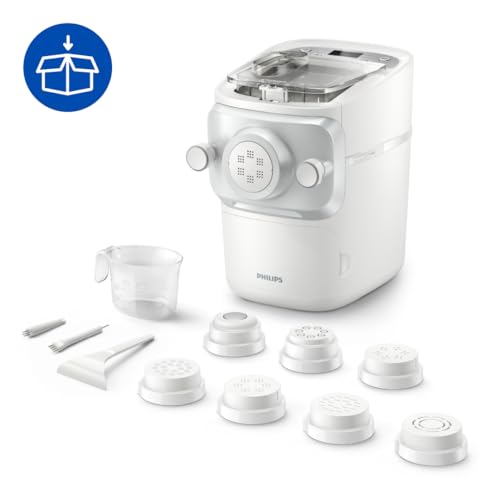
- Discs8 (Philips)
- Warranty2 years (Philips)
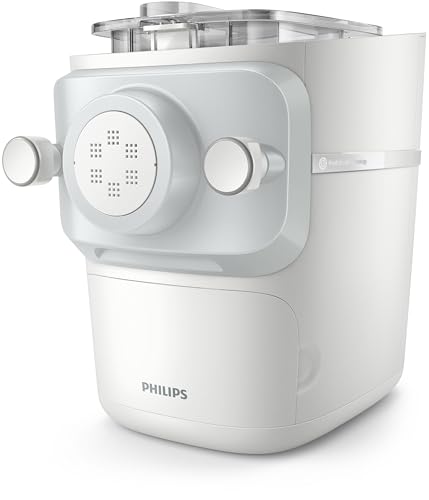
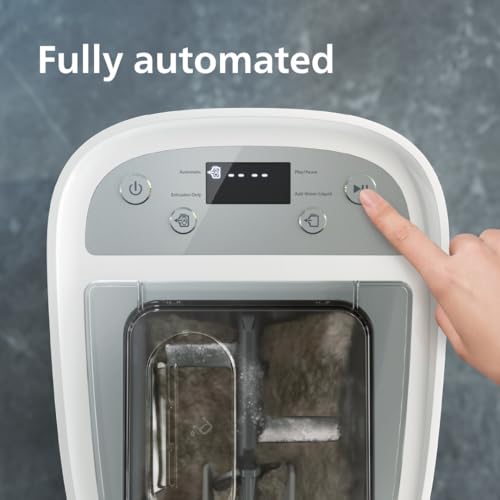
The Philips 7000 Series Pasta Maker (model HR2660/03) is a fully automatic machine: you put in flour and liquid, and it mixes, kneads, and pushes the dough through a shaping disc. Philips’s U.S. page lists a 150 watt motor, 8 discs, and a 2-year warranty. This review covers what Philips’s page and the Amazon listing say about it, where they differ, and who will use it enough to justify the counter space.
In short, it suits a household that wants fresh extruded pasta with little effort and likes to switch shapes. It is a poor fit for someone who wants lasagna sheets, filled pasta, or a machine that tucks away in a drawer.
This guide is general product information, not repair or electrical safety advice. Pasta machines have motors and moving parts. Unplug the machine before you clean or move it, follow the instructions in your product’s manual, and contact the manufacturer or an authorized service center if a unit sparks, overheats, or has a damaged cord.
CrumbWright is reader-supported. As an Amazon Associate, we earn from qualifying purchases.
Philips 7000 Series Pasta Maker (HR2660/03)


As an Amazon Associate we earn from qualifying purchases.
Philips 7000 Series Pasta Maker at a Glance
| Detail | What the sources say |
|---|---|
| Model | HR2660/03 (Philips page, Amazon listing) |
| How it works | Fully automated mixing, kneading, and extruding (Philips page) |
| Motor | 150 watts (Philips page) |
| Shaping discs | 8; Philips notes the number may vary per model (Philips page) |
| Warranty | 2 years (Philips page) |
| Size | 12.87 by 9.02 by 12.68 inches (Amazon listing) |
| Cleanup | Non-stick, dishwasher-safe parts (Amazon listing) |
| Not stated | Voltage, flour capacity, and weight are not on Philips’s page |
Who the Philips 7000 Series Is For
This machine is for people who like fresh pasta but do not want to make the dough. Philips describes the process as pouring the ingredients in and letting the machine do the rest. That makes it a reasonable fit for a household that eats pasta weekly, for a cook who wants to try different shapes without changing technique, and for someone who finds kneading by hand tiring.
It also suits people who like to experiment with flour types. Philips’s page includes a footnote comparing pasta made with 100 g of wheat flour against pasta made with 100 g of lupin, lentil, or white bean flour. The page does not give recipes or limits for those flours, so check the recipe book and manual before you try them.
What We Like
- Fully automated. Philips’s page calls the machine fully automated and says you pour the ingredients in and let it do the rest. Mixing, kneading, and shaping happen in one unit.
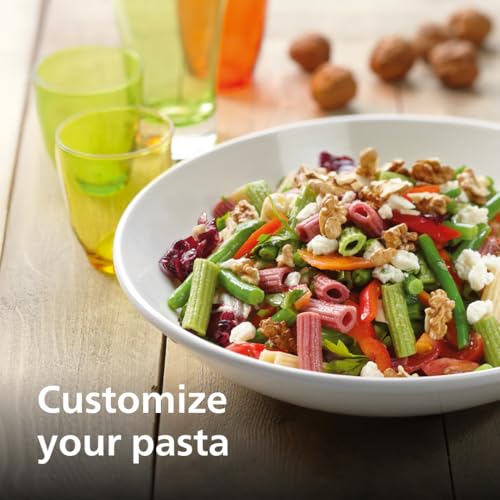
- Eight discs. Philips lists 8 discs. A manual roller makes sheets and a few cuts; this makes a spread of extruded shapes.
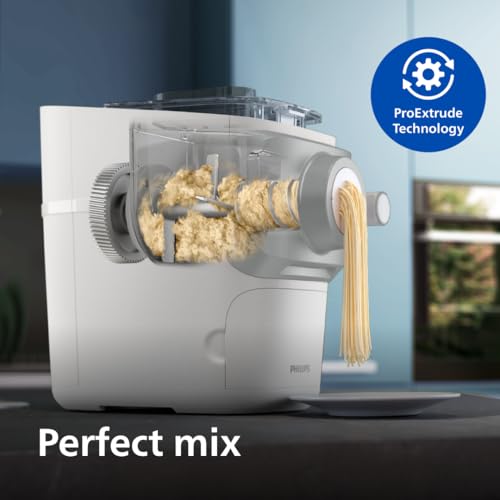
- Mixing hardware described in detail. Philips says the mixing chamber and a metal blending bar are designed to produce an even dough base, and that a metal mixing paddle and metal front panel are part of its ProExtrude design.
- Cleanup. According to the Amazon listing, the parts are non-stick and dishwasher safe, and the set includes a cleaning tool and a measuring cup.
- Two-year warranty. Per Philips’s U.S. page.
What Could Be Better
- It takes real space. The listing gives 12.87 by 9.02 by 12.68 inches, which is a lot more than a hand-cranked roller. It is not something to store casually in a small cabinet.
- Philips’s page leaves out basics. It does not state voltage, flour capacity, or weight. The listing’s weight figure conflicts with other figures we saw, so we do not repeat it. Check your manual before you buy if any of these matter to you.
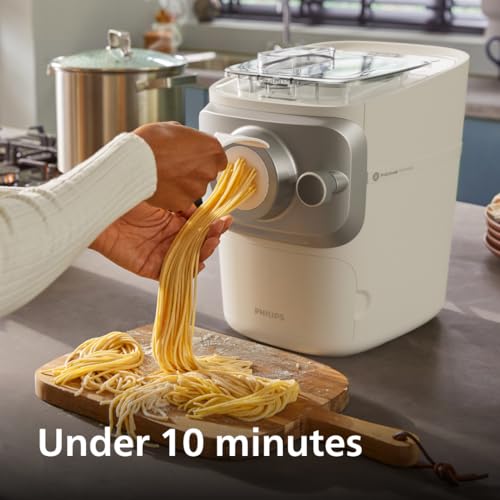
- The speed claim has fine print. The page says pasta in under 10 minutes, and a footnote says that figure is preparation time for 250 g of pasta, which it equates to 2 to 3 portions. The 8 portions in the listing are estimated by Philips from 700 g of pasta. Plan around the smaller batch if you want the shortest time.
- App claims differ by source. The Amazon listing mentions the HomeID app for recipes. The Philips page we opened did not mention an app, so confirm that with Philips before it influences your decision.
- Shapes are limited to the discs. The page itself says the disc count may vary by model, so check what is in the box.
What the Sources Say About Use
Philips’s page makes four specific claims about how the machine works. It says ProExtrude combines a powerful motor, a robust metal mixing paddle, and a strong metal front panel for a smooth finish. It says a mixing chamber and metal blending bar help make an even dough. It describes the machine as fully automated. And it gives a preparation time for a 250 g batch. Those are the maker’s statements, not our findings, and the page does not explain how any of them was measured.
The Amazon listing adds two points that the Philips page does not. It says the mixing function can be used for cookie dough and to kickstart the prep of pizza, bread, and more. It also says a batch can serve up to 8 portions. Treat the extra uses as a bonus, not a reason to buy: the listing does not give a limit for dense doughs, and Philips’s page does not mention them.
How to Read the Specs
Philips’s U.S. page lists 150 watts. The model code matters, because a figure on a page for a different code may not apply. This review covers HR2660/03, the model on the U.S. page and in the Amazon listing title. Do not assume that a figure for another code applies.
Capacity needs the same care. The numbers in play are 250 g for 2 to 3 portions on the page, and 700 g for 8 portions in a footnote. Neither is a flour capacity limit, and the page does not give one. If you plan to cook for a crowd, find the maximum batch in the manual before you rely on the 8-portion figure.
How It Compares
Within Philips’s range, the main alternative on Amazon is the Viva Collection Compact (HR2370/05). According to its listing, it makes 2 to 3 servings in about 18 minutes with three included discs for spaghetti, penne, and fettuccine. The listing’s size is 15.5 by 13 by 11.9 inches, so despite the name it does not take less space than the 7000 Series on paper. Choose it only if you want a smaller batch and fewer shapes.
Against a hand-cranked roller such as the Marcato Atlas 150, the trade-off is effort for flexibility. A roller makes sheets for lasagna and filled pasta and stores compactly, but you make the dough yourself. This machine does the mixing and extruding, but not sheets.
Who Should Look Elsewhere
Skip it if you want lasagna sheets, ravioli, or other rolled pasta, because it extrudes. Skip it if you have little storage or counter space. Skip it if you want a maker-stated flour capacity before you buy, since Philips’s page does not give one. And skip it if you only make pasta a few times a year, because a roller costs less space for occasional use.
Care and Safety
The listing says the parts are non-stick and dishwasher safe, but check your manual for which parts and which rack. We searched the U.S. Consumer Product Safety Commission recall database for Philips pasta makers and pasta machines and found no recall for this model. The search has limits, so check cpsc.gov before you buy. Unplug the machine before you clean it, and do not use it if the cord or housing is damaged.
Why You Should Trust Us
We do not run our own product trials. Our reviews draw on published product information from the maker and the Amazon listing, which we label, and on Amazon owner ratings, which also set each product’s CrumbWright Score. Commissions from Amazon links never affect a rating or a score. Details are on How We Review.
Final Verdict
The Philips 7000 Series is a sensible choice for a household that wants automatic extruded pasta and will use the machine often enough to give it space. The 8 discs and the dishwasher-safe parts are its strengths, and the unexplained gaps on Philips’s page (capacity, voltage, weight) are its weakness. If you want sheets and cuts, buy a roller instead.
Frequently Asked Questions
Is the Philips pasta maker fully automatic?
Yes. Philips’s U.S. page describes the 7000 Series as fully automated: you add the ingredients and the machine mixes, kneads, and extrudes.
How many shapes can the Philips 7000 make?
Philips lists 8 discs for the HR2660/03 and notes that the number of discs may vary per model. Check what is in the box.
How long does it take to make pasta?
Philips says under 10 minutes, and a footnote ties that to preparation time for 250 g of pasta, which it equates to 2 to 3 portions.
Are the parts dishwasher safe?
According to the Amazon listing, yes. Check your manual for which parts can go in the dishwasher.
Does the Philips pasta maker make lasagna sheets?
The sources describe shaping discs, not rolled sheets. For lasagna sheets, a roller such as the Marcato Atlas 150 is the usual tool.
Sources
About the author

Evelyn Curtis has enjoyed baking bread and pastries at home for six years. She covers stand mixers, dough kneading, KitchenAid attachments and mixer care for CrumbWright. Her guides draw on manufacturer documentation and product specifications to help home bakers compare features, understand capacity limits and choose suitable accessories.