
Smeg Stand Mixer vs KitchenAid: SMF04 vs Artisan KSM150PS
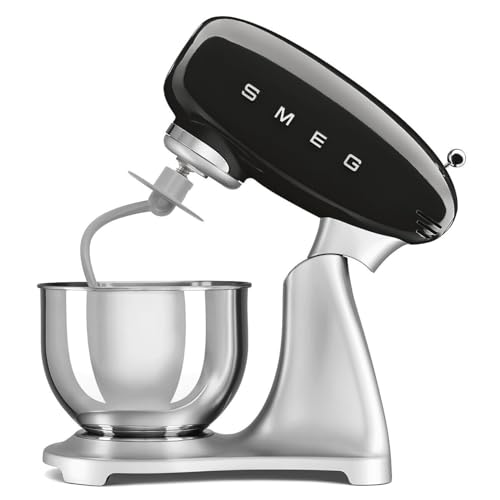
- Smeg SMF04 motor600 W
- Smeg SMF04 height, head up19 in
- Smeg SMF04 net weight21 lb
The Smeg SMF04 and the KitchenAid Artisan KSM150PS are the two 5 quart tilt-head mixers that shoppers most often weigh against each other when looks and counter presence matter as much as capacity. The short answer: choose the Smeg if you want a motor with a higher listed wattage and a maker that publishes its load limits, including a dough weight, a hydration floor, and ranges for egg whites and whipped cream. Choose the Artisan if you prefer KitchenAid’s tilt-head, which is listed a little shorter when closed, and you are comfortable with a maker page that gives a Flour Power Rating and a cookie count but no dough weight limit. Neither is a clear winner on the published evidence, and this comparison explains why.
This is a research-based comparison of published information, not a bench trial. Smeg’s and KitchenAid’s own U.S. product pages are the source for the figures below. This page contains Amazon affiliate links. If you buy through them we may earn a commission at no extra cost to you, and commissions never affect how we rate or rank a product.
This guide is general product information, not repair or electrical safety advice. Follow the safety instructions in your product’s manual, supervise children, and contact the manufacturer or an authorized service center if a product sparks, overheats, or has a damaged cord.
CrumbWright is reader-supported. As an Amazon Associate, we earn from qualifying purchases.
Smeg SMF04


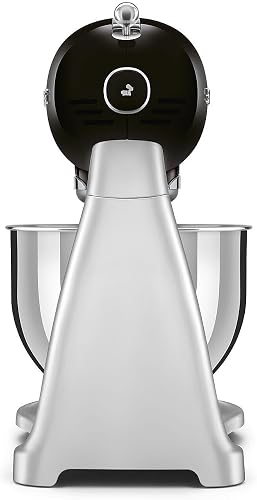
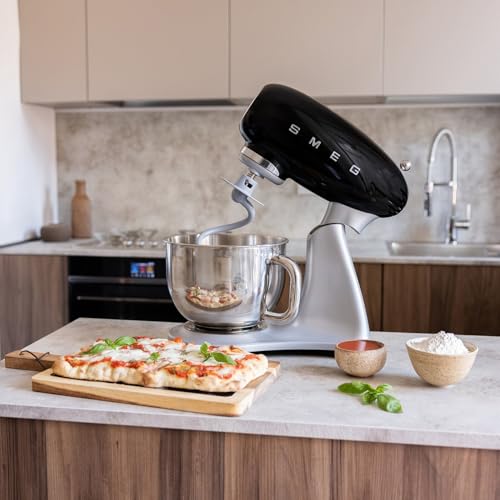
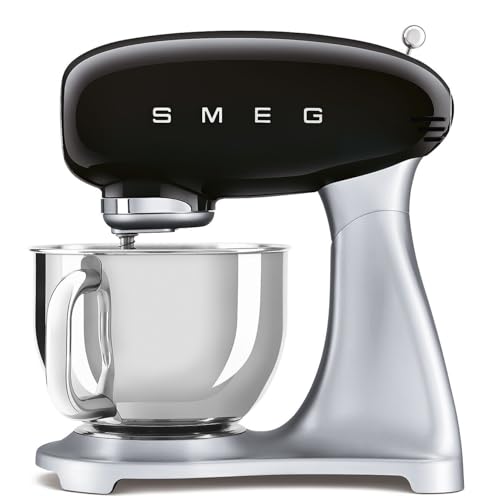
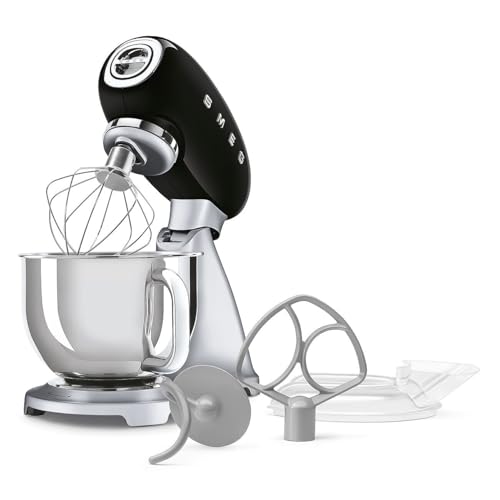
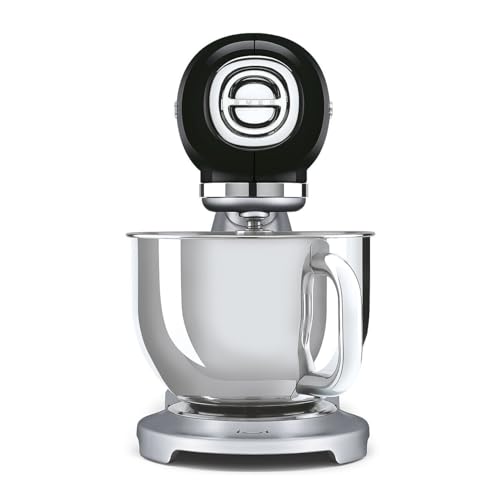
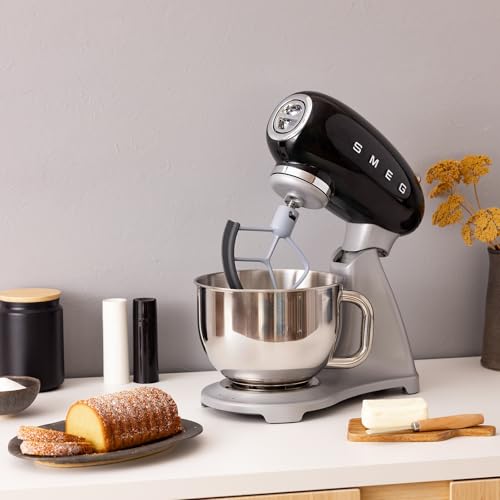
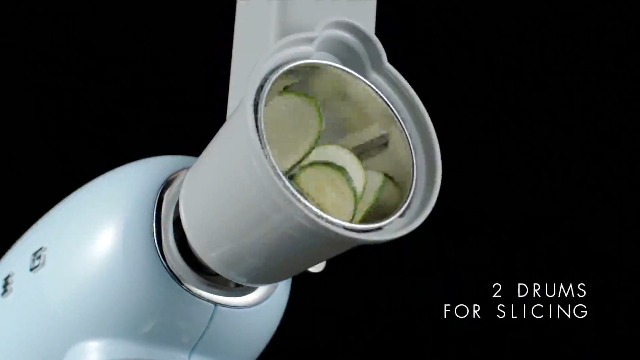
As an Amazon Associate we earn from qualifying purchases.
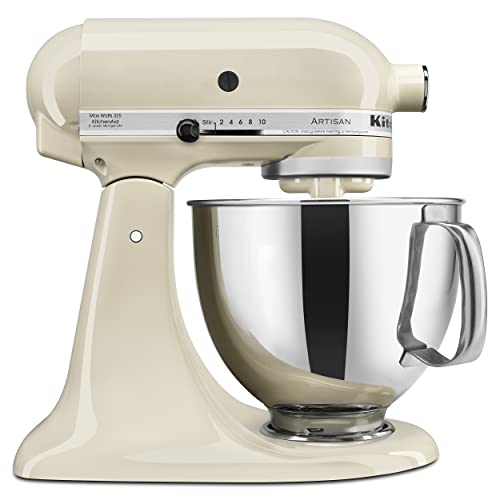
KitchenAid Artisan 5 Quart
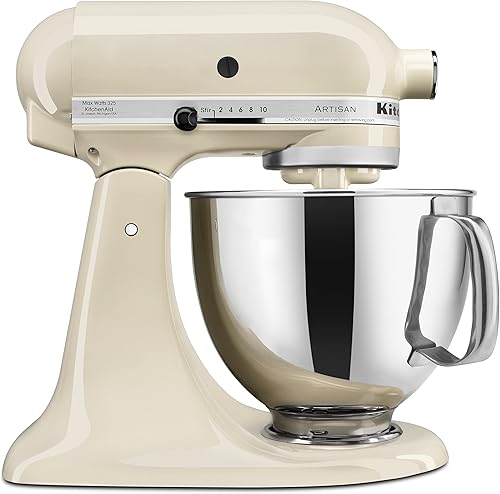


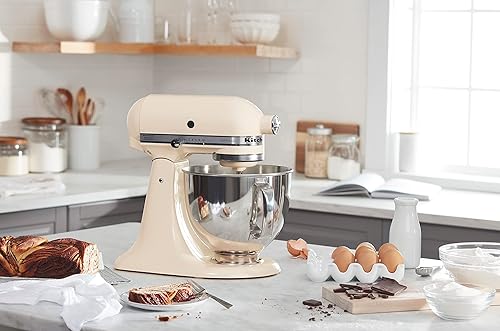

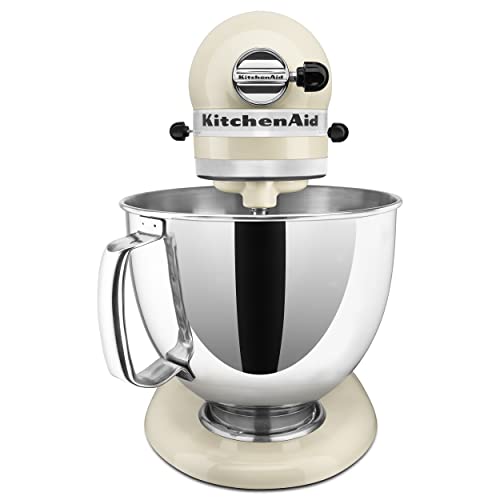
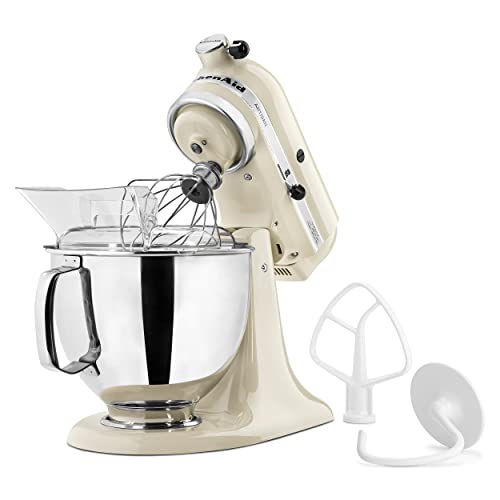


As an Amazon Associate we earn from qualifying purchases.
Smeg SMF04 vs KitchenAid Artisan KSM150PS: Side by Side
Smeg and KitchenAid figures come from the makers’ U.S. product pages. Scroll sideways on a phone to see both columns.
| Feature | Smeg SMF04 (maker page) | KitchenAid Artisan KSM150PS (maker page) |
|---|---|---|
| Bowl | 5 quart (4.8 L), stainless steel, with handle | 5 quart stainless steel, with handle |
| Head design | Tilt-up by button; safety lock when the head is up | Tilt-head; the Amazon listing says to “lock the head in place while mixing” |
| Motor | 600 W, direct drive, planetary action | 325 W |
| Speeds | 10, electronic speed control, Smooth Start | 10 |
| Electrical | 120 V, 60 Hz, 1 m cord | 120 V, 60 Hz |
| Weight | 21 lb net on the maker page (the Amazon listing says 19 lb) | 26.1 lb shipping weight |
| Height | 14 7/8 in closed, 19 in with the head up | 13-29/32 in; head position not stated |
| Stated load limits | Bread, pizza, or pasta dough: 4.2 lb total (up to 2.6 lb flour, at least 55% hydration). Egg whites: 2 to 12. Whipped cream: 3.4 to 34 oz | Flour Power Rating of 9 cups; up to 9 dozen cookies. No dough weight limit stated |
| Included | Wire whisk, flat beater, dough hook, bowl, pouring shield | Coated flat beater, coated dough hook, 6-wire whip, bowl, pouring shield |
| Attachments | Front accessory port; Smeg lists pasta, ice cream, grinder, and slicer accessories, sold separately | Not listed in the specifications |
What Each Maker Actually Publishes
The biggest difference between these two is not a number on the table. It is how much each source commits to in writing. Smeg’s U.S. page has a capacity block with separate limits for bread dough, dessert batter, cake batter, egg pasta dough, egg whites, and whipped cream. KitchenAid’s page for the Artisan gives a Flour Power Rating of 9 cups and up to 9 dozen cookies. A cookie count is useful for baking cookies. It tells you very little about how much bread dough the mixer will carry.
Smeg’s dough figure comes with conditions. It is 4.2 lb of total dough, of which no more than 2.6 lb is flour, and Smeg states it for dough at 55% hydration or wetter. That last condition matters because a stiffer dough, such as a bagel dough, is drier than that and falls outside the figure Smeg publishes. The 4.2 lb figure also limits total weight, not flour weight, so a wetter dough reaches it with less flour. As rough arithmetic, a dough at 70% hydration weighs about 1.7 times its flour (flour plus 0.7 of that weight in water, ignoring salt and yeast), which puts 4.2 lb of total dough at roughly 2.5 lb of flour.
KitchenAid does publish bread figures elsewhere in its line. KitchenAid says its 5.5 quart and 7 quart bowl-lift models can knead over 7 lbs and over 8.5 lbs of bread, respectively. So if large or frequent bread batches are the main job, the KitchenAid comparison points toward a bowl-lift rather than toward the Artisan.
Motor and Wattage
Smeg lists 600 W with a direct-drive motor and planetary action, where the beater orbits as it turns. KitchenAid lists 325 W for the Artisan and does not describe the motor type. On paper the Smeg is the stronger of the two, and Smeg backs the number with a dough limit. Wattage is a rating, not a measure of kneading ability, and makers do not state how they measure it, so we would not treat 600 W against 325 W as a verdict. What we can say is that the Smeg pairs a higher rating with a published limit, and the Artisan pairs a lower rating with none.
Head Lock, Stability, and Headroom
Both are tilt-head mixers: you raise the head to reach the bowl and lower it before mixing. Smeg describes a button-release head that locks when raised, and a Steady-Mix system that, in Smeg’s words, “minimizes the machine’s vibrations during mixing, allows for a gentle opening of the motor head and prevents its accidental closure.” The page also lists an anti-slip base and overload motor protection. The Artisan listing says only that you can lock the head in place while mixing, and the listing text we reviewed does not describe a lock for the raised position.
Headroom is where a tilt-head can surprise you. Smeg lists 14 7/8 inches closed and 19 inches with the head up. KitchenAid lists the Artisan at 13-29/32 inches and does not say whether that is closed or raised; it is probably the closed height. Either way, the raised height will be taller, so measure the space under your cabinets with the head open before you buy. The listed weights differ too: Smeg lists 21 lb net, and KitchenAid lists 26.1 lb shipping weight for the Artisan. Net and shipping weights are not the same measure, so use them for a rough sense of scale. Heavier is not automatically steadier, and neither maker publishes a stability rating.
Accessories and Attachments
Smeg’s page lists a front accessory port and a set of optional Smeg accessories sold separately: a pasta roller, a fettuccine maker, a tagliolini cutter, a spaghetti maker, an ice cream maker accessory, a multi food grinder, and a vegetable slicer, along with spare beaters, a spare dough hook, a whisk, and a bowl. It also says the flat beater, dough hook, and pouring shield are dishwasher safe. KitchenAid’s other listings, for the Classic and the 5.5 quart bowl-lift, mention more than ten optional attachments, and the Classic listing also names a power hub, but the Artisan listing text we reviewed does not mention attachments at all.
Attachments are made for each maker’s own mixers. Do not assume that a Smeg accessory fits a KitchenAid or the reverse, and check the compatibility line for any attachment you plan to buy.
Where the Listings Disagree
- Weight. Smeg’s page says 21 lb net; the Amazon listing for the SMF04 says 19 lb. KitchenAid lists a 26.1 lb shipping weight for the Artisan.
- Controls. The Amazon listing for the SMF04 says its controls are a knob; Smeg’s page lists a lever. Check the photos for the color you want.
- Name. Smeg’s page title calls the SMF04 a Classico, while its on-page heading says Forte, and the Amazon listing says Classico. Match the model code, not the name.
- Dimensions. The two Amazon listings label their depth and width differently, so we compare only heights.
Which Should You Buy?
Choose the Smeg SMF04 if you want load limits in writing from the maker, a motor with the higher rating, a lock on the raised head, and dishwasher-safe beater and hook. Be sure you have the headroom for a 19 inch raised head, and read the warranty terms with whoever sells it, because the Smeg listing we reviewed was sold by a third-party seller while the Artisan listing was sold by Amazon.com. Seller details change, so check the listing when you buy.
Choose the KitchenAid Artisan KSM150PS if you prefer KitchenAid’s design and a slightly lower closed height, you mostly bake cookies, cakes, and the occasional loaf, and you are comfortable with a page that gives a Flour Power Rating and a cookie count but no dough weight limit.
Who Should Look Elsewhere
- Frequent bread bakers. Neither is built around large dough batches. Smeg’s own limit is 4.2 lb of total dough, and the Artisan states none. A bowl-lift is the usual step up.
- Stiff dough makers. Smeg states its dough limit only at 55% hydration or wetter, so bagels and other drier doughs sit outside what it publishes.
- Small kitchens with low cabinets. A raised Smeg head reaches 19 inches. Measure first.
- Buyers who need a stated bread dough weight for the Artisan. KitchenAid gives a Flour Power Rating and a cookie count, not a dough weight.
Care and Safety
Follow the manual that comes with either mixer. Keep hands, spatulas, and utensils out of the bowl while it runs, unplug it before changing attachments, and stop using it if the cord is damaged, if it sparks, or if it overheats. Contact the maker or an authorized service center in those cases. Smeg’s U.S. page also carries a California Proposition 65 warning; read it on the page before you buy.
Why You Should Trust Us
We do not conduct our own product trials; our picks draw on published specifications from the makers and Amazon owner ratings, which also set each product’s CrumbWright Score. Commissions from Amazon links never affect a rating or a score. Details are on our How We Review page, and you can browse the stand mixers category for other models.
Final Verdict
The Smeg SMF04 gives you more to check before you buy: a higher motor rating, a stated head lock, and written load limits, with the caveat that the dough limit is modest and conditional. The Artisan is the quieter page, with fewer claims about load. If you want to know what the machine is designed to handle, the Smeg is easier to evaluate on paper. If you want KitchenAid’s tilt-head format and your baking stays within cookies, cakes, and the occasional loaf, the Artisan fits. If bread is the point, look at a bowl-lift model instead.
Frequently Asked Questions
Is the Smeg SMF04 as good as a KitchenAid?
On paper it compares well: a higher motor rating, a locking raised head, and stated load limits. What we cannot say is how either behaves in a kitchen, because we do not run our own product trials.
Which one handles more bread dough?
Smeg publishes 4.2 lb of total dough for the SMF04, at 55% hydration or wetter. KitchenAid gives the Artisan no dough weight limit. Its bowl-lift models, not the Artisan, carry bread figures of over 7 lbs and over 8.5 lbs.
Do Smeg and KitchenAid attachments fit each other’s mixers?
Do not assume so. Each maker lists its own accessories for its own mixers. Check the compatibility line for the exact model before buying an attachment.
Is the SMF04 the Classico or the Forte?
Smeg’s own page uses both names for SMF04CRUS: Classico in the page title and Forte in the heading. The Amazon listing for the SMF04 says Classico, and a separate Amazon listing for the SMF05 says Forte with 750 W. Go by the model code.
How tall is each mixer?
Smeg lists 14 7/8 inches closed and 19 inches with the head up. KitchenAid lists the Artisan at 13-29/32 inches without saying whether the head is raised. Plan for more clearance than the closed height on either.
Sources
- Smeg SMF04 U.S. product page (the SMF04BLUS page showed the same figures)
- KitchenAid Artisan 5 Quart (KSM150PS) product page
- U.S. Consumer Product Safety Commission recall database (searched by brand and model name for this article; a keyword search, not a lot-number search)
About the author

Evelyn Curtis has enjoyed baking bread and pastries at home for six years. She covers stand mixers, dough kneading, KitchenAid attachments and mixer care for CrumbWright. Her guides draw on manufacturer documentation and product specifications to help home bakers compare features, understand capacity limits and choose suitable accessories.