
Cuisinart vs KitchenAid Stand Mixer: SM-50 vs Artisan KSM150PS
The Cuisinart SM-50 and the KitchenAid Artisan KSM150PS are two popular mixers in the 5 to 5.5 quart range for home baking. The short answer: on the published information, neither one is a clear winner, and which fits better depends on what you value. Choose the Cuisinart if you want the larger bowl, the higher motor rating, and the longer list of included items shown in its Amazon listing. Choose the KitchenAid Artisan if you value the maker’s published care and adjustment pages, a documented range of attachments, and a smaller 5 quart bowl.
This is a research-based comparison of published information, not a bench trial. The Cuisinart bowl, motor, speed, weight, and size figures below are per Cuisinart, the other Cuisinart details are per the Amazon listing, and the KitchenAid Artisan figures are per KitchenAid’s product page unless a row says otherwise. We also use KitchenAid’s U.S. Product Help pages for general care and setup points that apply to its tilt-head mixers.
This comparison is general product information, not repair or electrical safety advice. Follow the safety instructions in your product’s manual, unplug the mixer before changing beaters or making adjustments, supervise children, and contact the manufacturer or an authorized service center if a product sparks, overheats, or has a damaged cord.
CrumbWright is reader-supported. As an Amazon Associate, we earn from qualifying purchases.
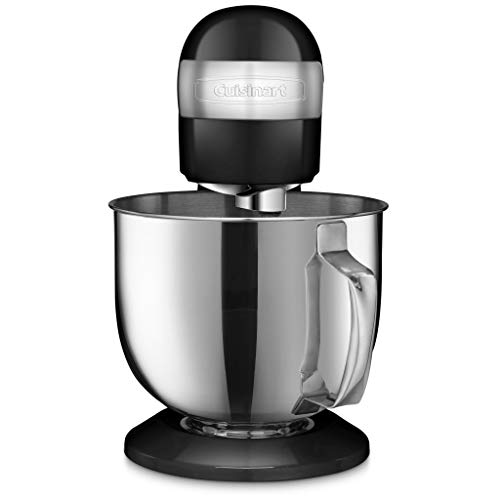
Cuisinart 5.5 Quart Stand Mixer
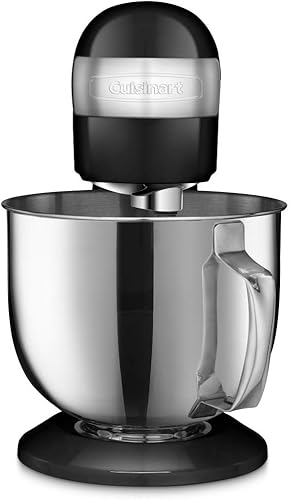


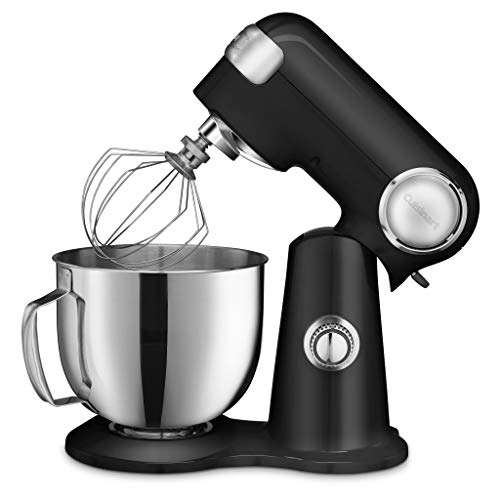
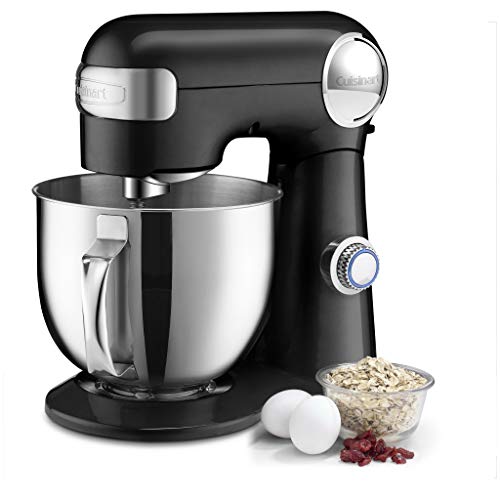

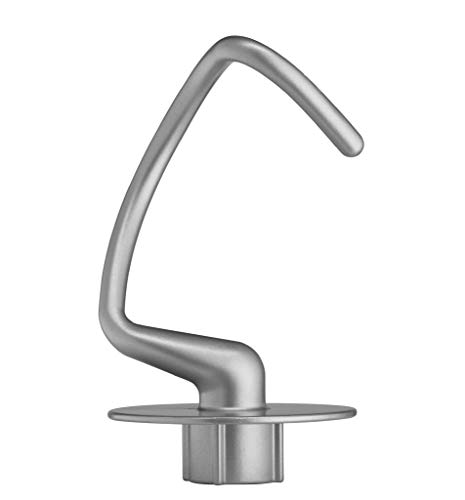


As an Amazon Associate we earn from qualifying purchases.
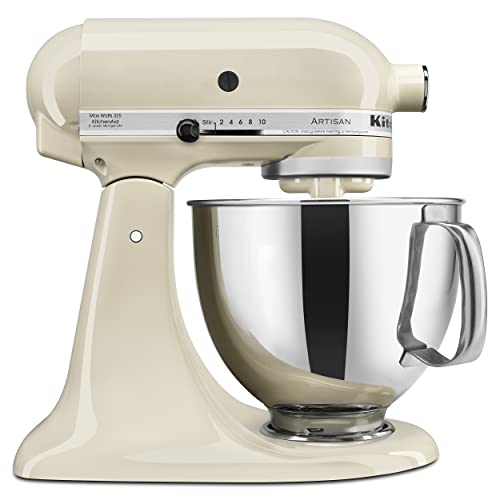
KitchenAid Artisan 5 Quart
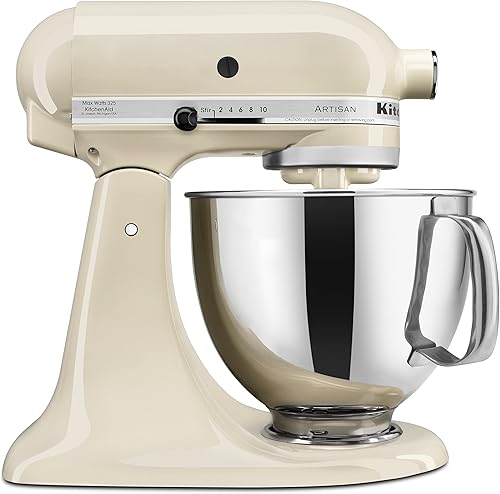


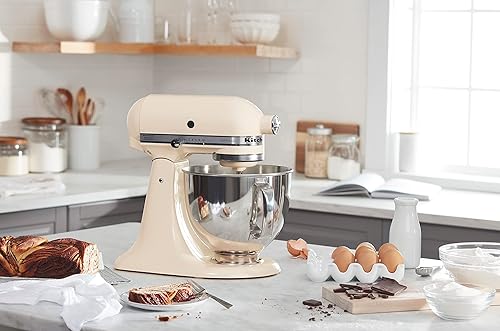

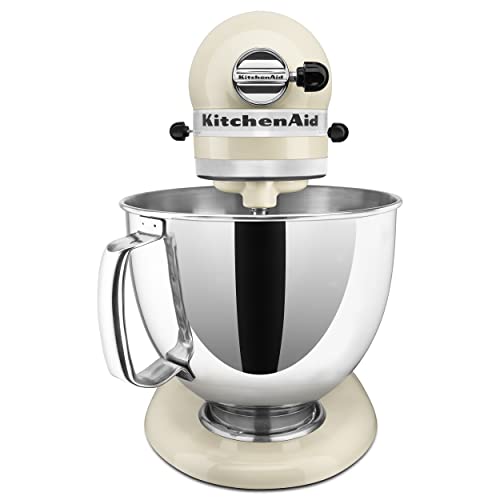
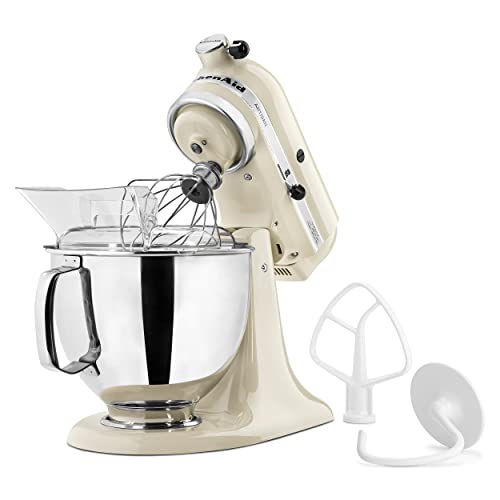



As an Amazon Associate we earn from qualifying purchases.
Cuisinart SM-50 vs KitchenAid Artisan KSM150PS: Side by Side
L = Amazon listing, M = maker page. Cuisinart bowl, motor, speed, weight, and size figures are M (per Cuisinart) and its other rows are L; KitchenAid figures are M unless a row says per the listing. Scroll sideways on a phone to see both columns.
| Feature | Cuisinart SM-50 (M/L) | KitchenAid Artisan KSM150PS (M) |
|---|---|---|
| Bowl | 5.5 quart stainless steel | 5 quart stainless steel with handle, dishwasher safe |
| Head design | Tilt-back head | Tilt-head; the listing says to “lock the head in place while mixing” |
| Motor | 500 W, die-cast metal construction | 325 W |
| Speeds | 12, knob control | 10 |
| Electrical | Spec table says “110 volts” | 120 V |
| Weight | 18.10 lb | 26.1 lb shipping weight |
| Height | About 14.1 in | 13-29/32 in (about 13.9 in) |
| Stated load limits | None stated | Up to 9 dozen cookies and a Flour Power Rating of 9 cups, per KitchenAid. No bread dough limit stated |
| Included | Chef’s whisk, dough hook, flat mixing paddle, splash guard with pour spout, manual, and recipe book | 5 quart bowl, coated flat beater, coated dough hook, 6-wire whip, 1-piece pouring shield |
| Dishwasher | Bowl and all accessories, per the listing description | Bowl |
| Attachments | One power outlet for optional attachments; the listing names pasta extruder, pasta roller and cutters, ice cream maker, meat grinder, and spiralizer | Attachment hub; see the Product Help pages below |
| Warranty | Cuisinart does not state a length on its page | Not listed |
What the Listings Leave Out
Neither the Cuisinart listing nor KitchenAid’s page gives the one number a bread baker most wants: how much bread dough the mixer can carry. The Cuisinart listing gives a bowl size and a motor rating but no dough limit. KitchenAid says up to 9 dozen cookies and gives a Flour Power Rating of 9 cups. A cookie count helps for cookies, but it says little about a stiff bread dough, which loads a mixer far more than a batter does. If you knead dough often, check each maker’s manual for the limit before you rely on either one.
The voltage field reads “110 volts” for the Cuisinart, while KitchenAid lists 120 V, and we do not read anything into the difference. KitchenAid also gives a shipping weight, which is not like for like with the Cuisinart’s listed weight, so we compare only height here, where the two are about the same at roughly 14 inches.
Motor Rating: Why 500 W Versus 325 W Is Not a Verdict
The Cuisinart’s 500 W is higher than the Artisan’s 325 W on paper. Wattage is a motor rating, and neither source says how it is measured or how it translates to the work the mixer does under load. A higher number is a reasonable signal that the Cuisinart was built around a stronger motor, but it does not by itself tell you which machine handles heavy dough better, stays steadier, or lasts longer. We therefore treat it as a point in the Cuisinart’s favor on paper, not a result.
Bowl, Weight, and Counter Space
The Cuisinart lists a 5.5 quart bowl against the Artisan’s 5 quart. That is a modest difference in capacity, and it matters most if you make large batches of batter or cream. Cuisinart lists 18.10 lb, and KitchenAid gives the Artisan a shipping weight of 26.1 lb, which includes packaging, so the two are not exact like for like. A heavier machine tends to stay put better during a stiff mix, which is a general point and not a claim from either listing. If you plan to lift the mixer on and off a shelf, the Cuisinart is probably easier to move.
Included Accessories and Attachments
The Cuisinart listing names a chef’s whisk, a dough hook, a flat mixing paddle, and a splash guard with pour spout, and says a manual and recipe book are included. KitchenAid lists a 5 quart bowl, a coated flat beater, a coated dough hook, a 6-wire whip, and a 1-piece pouring shield for the Artisan.
Both makers document add-on attachments. The Cuisinart listing says its power outlet takes a pasta extruder, a pasta roller and cutters, an ice cream maker, a meat grinder, and a spiralizer. KitchenAid’s Product Help documents hub attachments on its mixers, including a 3-in-1 pasta attachment (How to Attach the 3-in-1 Attachment), which says to unplug the mixer, remove the hub cover, seat the shaft in the hub socket, and tighten the hub knob. We found no source saying attachments are interchangeable between the two brands, so do not assume one brand’s attachment fits the other’s mixer.
Care, Adjustment, and Replacement Parts
This is where the published sources differ most. For KitchenAid tilt-head mixers, the Product Help Beater-to-Bowl Clearance guide describes a beater-to-bowl clearance screw in the neck hinge. It says to turn the screw clockwise to lower the beater and counterclockwise to raise it, in small steps of no more than 1/8 to 1/4 of a turn, within an overall range of about 1/2 turn, with the mixer unplugged. It gives symptoms to look for: unmixed ingredients at the bottom mean the beater sits too high, and scraping or clicking means it sits too low. The page is written for KitchenAid tilt-head models in general, so check your manual for the Artisan specifically.
KitchenAid’s Beater Care page says some beaters are dishwasher safe and others are not, that replacement beaters are available for tilt-head models, and that stainless beaters are available for all tilt-head mixers except the Artisan Mini and the Accolade. It also notes that the coated beaters should be checked against the bowl clearance regularly to prevent chipping. We found no equivalent care, adjustment, or parts guidance for the Cuisinart, so we do not compare on this point; check the Cuisinart manual.
Which Should You Buy?
Choose the Cuisinart SM-50 if
- You want the larger 5.5 quart bowl and the higher listed motor rating.
- You prefer a listing that names the included whisk, dough hook, paddle, and splash guard.
- You want a lighter machine to move around, per the listings.
Choose the KitchenAid Artisan KSM150PS if
- You want a maker that publishes beater care, clearance adjustment, and attachment pages you can read online.
- You like a 5 quart bowl and a tilt-head you lock in place while mixing.
- You want replacement beaters, since KitchenAid’s Product Help page says replacement beaters are available for tilt-head models.
- You are comfortable confirming warranty terms with KitchenAid, since the Amazon listing gives none.
Who Should Look Elsewhere
- Bakers who knead stiff bread dough most weeks. Neither listing gives a dough limit, and both machines are tilt-back or tilt-head designs. A bowl-lift model with a published dough capacity may suit that work better.
- Anyone who needs a confirmed warranty or a stated dough capacity. Neither source gives a dough capacity, and no KitchenAid warranty is listed here.
- Shoppers who want a price comparison. We do not publish prices because they change constantly, so check current listings yourself.
Why You Should Trust Us
We do not conduct our own product trials; our comparisons draw on Amazon listings, published maker help pages, and Amazon owner ratings, which also set each product’s CrumbWright Score. Commissions from Amazon links never affect a rating or a score. Details are on our How We Review page, and you can browse the stand mixers category for other models.
Final Verdict
The Cuisinart SM-50 offers more on paper: a bigger bowl, a higher motor rating, more speeds, and a listing that names its accessories. The KitchenAid Artisan KSM150PS offers a maker that publishes care and adjustment pages for its tilt-head line and an attachment range it documents online. Because neither source states a dough limit, we do not name an overall winner. If you want a better-documented ownership experience, lean KitchenAid. If you want more hardware in the listing, lean Cuisinart, and read its manual first.
Frequently Asked Questions
Is a Cuisinart stand mixer a good alternative to a KitchenAid?
It can be, for light to moderate home baking. The Cuisinart SM-50 lists a larger bowl and a higher motor rating than the Artisan, but neither source states a dough capacity.
Which has more power, Cuisinart or KitchenAid?
Cuisinart lists 500 W for the SM-50 and the Artisan listing says 325 W. Wattage is a motor rating and does not by itself predict how well a mixer handles dough, so treat the gap as a signal, not a result.
Which comes with more accessories?
According to its Amazon listing, the Cuisinart names a whisk, dough hook, flat paddle, and splash guard. KitchenAid lists a bowl, a coated flat beater, a coated dough hook, a 6-wire whip, and a pouring shield for the Artisan.
Do KitchenAid and Cuisinart attachments fit each other’s mixers?
We found no source saying so. Cuisinart’s listing names its own range of optional attachments, and KitchenAid documents its own hub attachments. Check the maker’s compatibility information before you buy any attachment.
Which is easier to maintain?
KitchenAid publishes online guidance for beater care and for adjusting beater-to-bowl clearance on its tilt-head mixers. We found no equivalent Cuisinart guidance, so we cannot compare. Read each manual.
Sources
- KitchenAid: Artisan Series 5 Quart Tilt-Head Stand Mixer (KSM150PS) specifications
- Beater-to-Bowl Clearance guide
- Beater Care page
- How to Attach the 3-in-1 Attachment
- U.S. Consumer Product Safety Commission recall database (searched by brand and model name; a keyword search, not a lot-number search)
- Cuisinart, Precision Master 5.5 quart stand mixer (SM-50) page
About the author

Evelyn Curtis has enjoyed baking bread and pastries at home for six years. She covers stand mixers, dough kneading, KitchenAid attachments and mixer care for CrumbWright. Her guides draw on manufacturer documentation and product specifications to help home bakers compare features, understand capacity limits and choose suitable accessories.